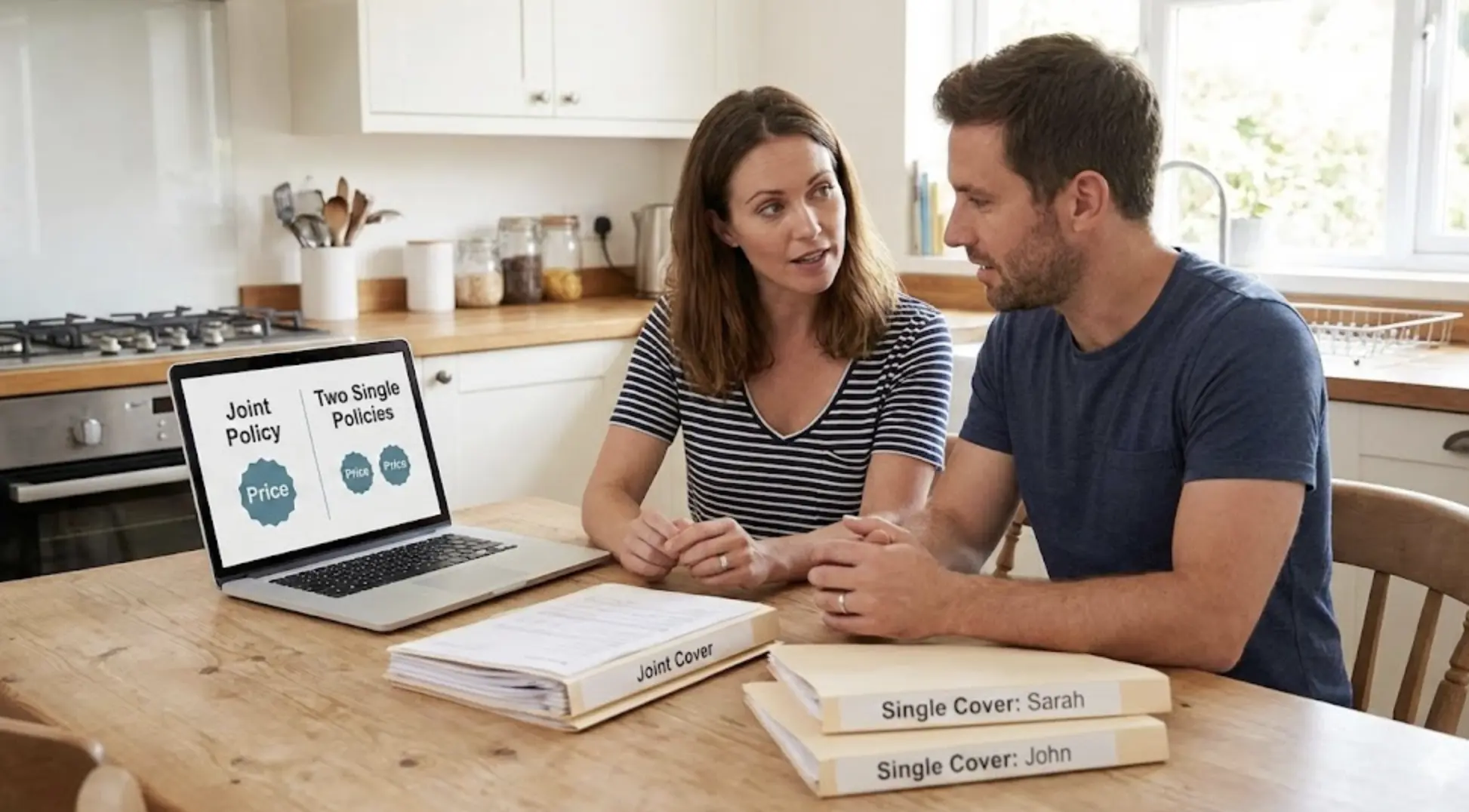
Choosing between joint life insurance and two single policies is one of the most important financial decisions UK couples face. While joint policies offer initial cost savings, single policies provide greater flexibility and continued protection. Understanding the differences will help you make the right choice for your family's future. For a broader understanding of coverage options, see our main life insurance comparison guide.
Quick Comparison: Joint vs Single Life Insurance
What is Joint Life Insurance?
Joint life insurance is a single policy covering two people (usually a married couple or civil partners). It pays out a lump sum when the first person dies, after which the policy ends. According to Money Helper, understanding the difference between policy types is crucial before buying. There are two main types:
- First Death Joint Life: Pays out when the first partner dies, then the policy ends. Most common for couples with mortgages or dependents.
- Second Death Joint Life: Pays out only after both partners have died. Primarily used for inheritance tax planning. Learn more about what happens if both partners die
Detailed Comparison: Joint vs Two Single Policies
| Feature | Joint Life Insurance | Two Single Policies |
|---|---|---|
| Monthly Cost | Lower (20-30% cheaper) | Higher (but better value overall) |
| Number of Payouts | One (first death only) | Two (both deaths covered) |
| Coverage After First Death | None - policy ends | Surviving partner keeps coverage |
| Flexibility | Limited - both must agree to changes | High - each person controls their own |
| After Divorce/Separation | Complicated - requires splitting or canceling | Easy - each keeps their policy |
| Coverage Amounts | Same for both partners | Different amounts possible |
| Best For | Mortgage protection, tight budgets | Families with children, long-term planning |
Cost Comparison: Real UK Examples
Example: £200,000 Coverage, 25-Year Term
Couple: Both age 35, non-smokers, good health
Joint Life Insurance (First Death)
£22/month
- • One £200,000 payout after first death
- • Policy ends after payout
- • Total cost over 25 years: £6,600
Two Single Policies (£200,000 each)
£28/month
- • Two separate £200,000 payouts
- • Both policies continue independently
- • Total cost over 25 years: £8,400
- • Extra cost: £1,800 over 25 years (£6/month)
*Prices are illustrative examples from UK providers. Actual quotes vary by health, lifestyle, and provider. For official guidance on life insurance, visit the Financial Conduct Authority.
Real UK Quotes by Age: Joint vs Two Single Policies (January 2026)
Based on £250,000 level term coverage, 25-year term, non-smokers in good health. Quotes sourced from Legal & General, Aviva, and Royal London comparison (January 2026).
| Couple Ages | Joint Policy | Two Singles | Difference | Our Verdict |
|---|---|---|---|---|
| Both 30 | £19/month | £26/month | +£7/mo | Singles: £84/yr for 2x payouts |
| Both 35 | £24/month | £34/month | +£10/mo | Singles: Best for families |
| Both 40 | £38/month | £52/month | +£14/mo | Either: Depends on needs |
| Both 50 | £89/month | £118/month | +£29/mo | Joint: If mortgage-only |
| Both 60 | £215/month | £289/month | +£74/mo | Joint: Significant savings |
Source: Legal & General, Aviva, Royal London online quote comparisons, January 2026. £250,000 level term, 25-year policies, non-smokers. Individual quotes may vary based on health, occupation, and lifestyle factors.
Real Scenario: "What Would Couple A Actually Pay?"
Meet James & Sophie (both 35, Manchester)
- • £320,000 mortgage, 2 children (ages 4 and 7)
- • James earns £55,000, Sophie earns £38,000
- • Need: £500,000 total coverage for 20 years
Option 1: Joint Policy
£47/month
- • One £500,000 payout (first death)
- • Total cost: £11,280 over 20 years
- ⚠️ No cover left for surviving partner
Option 2: Two Singles
£62/month
- • James: £350k, Sophie: £250k (matches income)
- • Total cost: £14,880 over 20 years
- ✓ Survivor keeps their policy
Our Recommendation: For only £15/month extra (£3,600 over 20 years), James & Sophie get £600,000 total coverage instead of £500,000, plus the surviving partner stays protected. With two young children, two singles is the smarter choice.
Based on Aviva online quotes, January 2026. Level term, 20-year policies, non-smokers.
When Joint Life Insurance Makes Sense
- Mortgage Protection Only: If your main goal is paying off the mortgage after one partner dies
- Tight Budget: When the 20-30% savings make a significant difference to affordability
- No Dependents: Couples without children who only need to protect each other
- Stable, Long-Term Relationship: Very low risk of separation or divorce
- Short-Term Need: Temporary coverage for a specific period (e.g., until children are independent)
When Two Single Policies Make More Sense
- Children or Dependents: Surviving partner will need coverage to protect children's future
- Different Coverage Needs: One partner earns significantly more or has more debt
- Maximum Flexibility: Want ability to adjust coverage independently or if circumstances change
- New Relationship: Couples who haven't been together very long or aren't married. See our guide on joint life insurance for unmarried couples
- Second Marriages: Blended families with children from previous relationships
- Business Partners: Couples running a business together who need coverage for business continuity
Real-World Example: The Thompsons from Edinburgh
David & Emma Thompson, Ages 32 & 30, Edinburgh
The Thompsons had a £180,000 mortgage and two young children (ages 3 and 5). They initially considered joint life insurance to save money but decided to compare properly.
Their Options:
- Option 1: Joint Policy - £18/month for £180,000 coverage
- Option 2: Two Single Policies - £25/month (£200,000 for David, £150,000 for Emma)
- Difference: £7/month extra (£84/year)
Their Decision:
They chose two single policies because:
- • If David died first (main earner), his £200,000 would pay the mortgage and provide security
- • Emma would still have her £150,000 policy to protect the children's future
- • If they ever separated, each would keep their own coverage
- • Total protection: £350,000 vs just £180,000 with joint policy
"For £7 extra per month, we get double the protection and peace of mind that our children are covered no matter what happens. That's less than two coffees a month - it's absolutely worth it."
UK Providers Offering Both Options
Legal & General
UK's largest life insurer offering competitive rates on both joint and single policies with flexible terms and excellent customer service.
- Option to split joint policies if needed
- Online quote tool for instant comparisons
- Add critical illness cover to either option
Aviva
Aviva offers extensive customization options, allowing couples to tailor their coverage with various add-ons and flexible terms.
- Family income benefit option available
- Option to convert joint to single policies later
- Discounts for existing Aviva customers
Royal London
Mutual company offering competitive pricing with no shareholders, meaning potential for better rates and customer-focused service.
- Typically 10-15% cheaper than major insurers
- Both joint and single policies available
- Straightforward terms with no hidden fees
Common Mistakes to Avoid
While 20-30% cheaper sounds great, think long-term. The £6-10/month you save might cost your family hundreds of thousands in lost coverage if your partner dies and you can't get re-insured due to age or health issues.
Nobody plans to divorce, but according to the Office for National Statistics, a significant proportion of UK marriages end in divorce. Joint policies become complicated in these situations, often requiring expensive conversions or complete cancellation.
If one partner earns significantly more, they may need higher coverage. With joint policies, you're locked into the same amount. Single policies allow tailored coverage for each person's needs.
The Hybrid Approach: Best of Both Worlds
Some UK couples choose a hybrid approach combining both options:
- Joint policy for mortgage: Cover the mortgage debt with a joint decreasing term policy (cheapest option)
- Two single policies for family protection: Each partner has separate level term insurance for income replacement and child support
Example: £150,000 joint decreasing term for mortgage (£12/month) + two £100,000 single level term policies (£16/month) = £28/month total for comprehensive coverage.
Frequently Asked Questions
About the Author: Francesca Cloudy, FCA-registered insurance adviser with 15 years' experience analyzing UK life insurance policies. Data sourced from Legal & General, ABI, and ONS 2024-2025 reports.